


The book of the Revelation of Jesus Christ starts out with John, exiled on the Isle of Patmos, receiving an Angelic message and then some incredible visions that are similar to those seen by the Prophet Daniel hundreds of years earlier.
The Greek name for the book of Revelation, A·po·kaʹly·psis (apocalypse), means “Uncovering” or “Disclosure.” This name indicates the meaning of Revelation—it uncovers matters that had been hidden and discloses events that would happen long after it was written. The apostle John penned the Revelation at the age of 92 while exiled as a prisoner of Rome on the remote Isle of Patmos. John was to write in a book the visions that he SAW during his exile, and send it to the 7 Churches who were operating in Asia Minor (modern Turkey).
At the time of the writing of Revelation, John was the last of the Apostles of the Lamb still alive and perhaps the last living apostle who had SEEN the Lord. He was therefore the best, and perhaps only, man available to complete the New Testament writings.
In this REVELATION, God unveils or unseals to Apostle John those things that will “soon take place” on the earth.
Obviously our “soon” is not the same thing as God’s “soon”, because it’s been almost 2000 years since the Revelation was written. Remember, to God, 1000 years is like a day, and a day is like 1000 years. (2nd Peter 3:8).
At the time of the writing of Revelation, John was the only among the Apostles of the Lamb still alive and perhaps the last living apostle who had SEEN the Lord. He was therefore the best, and perhaps the only, man available to complete the New Testament cannon.
In Revelation 1:1-2, Apostle John reveals the Revelation of Jesus Christ, which God gave Him to show to His bond-servants, the things which must soon take place; and He sent and communicated it by His angel to His bond-servant John, 2 who testified to the word of God and to the testimony of Jesus Christ, even to all that he saw…
The Angel of the Lord tells John to WRITE to the seven churches in Asia Minor (Modern Turkey) a message from the Triune God (God the Father, Son and Holy Spirit). It was a message of correction, encouragement, and of hope.
What or WHO is being REVEALED in this book?
- Jesus Christ, His Glory, His Divinity and God’s Heavenly Kingdom
- Apocalyptic events that will precede HIS 2nd coming are also being revealed.
- The cosmic war that goes on between the forces of Good and evil in the spiritual realm
- God revealed to Apostle John the things which must soon take place as well as the testimony of Jesus Christ, even to all that he saw
- In this Revelation also, God unveils or unseals those things that will “soon take place”on the earth
The Angel of the Lord tells John to WRITE to the seven churches in Asia Minor (Modern Turkey) a message from the Triune God (Father, Son, Holy Spirit), a message of correction, a message of encouragement, a message of hope. The question is, if the events of the Revelation are End-Time events that have yet to happen,
Apostle John writes the letters to the 7 churches as instructed by God. This is what he wrote;
- Ephesus: Praised for its hard work but rebuked for leaving its first love.
- Smyrna: Commended for enduring suffering and persecution, described as a suffering church.
- Pergamum: Praised for its faithfulness in a city of pagan worship but warned about compromising with certain teachings.
- Thyatira: Recognized for its love and service but criticized for tolerating a false prophetess.
- Sardis: A church that was considered spiritually dead, with a few who remained faithful.
- Philadelphia: A faithful and steadfast church, praised for patiently enduring and keeping God’s word.
- Laodicea: A “lukewarm” church with a strong warning to repent, known for being spiritually apathetic
The letters, delivered by John, contain both challenges and encouragement and were sent to actual churches in Asia Minor (modern-day Turkey). Each message has a similar structure and is often interpreted as representing different eras of the Christian church or different spiritual states within individuals.
God was letting these churches know that He understood their challenges and influences and was encouraging them to REPENT of misdeeds and to hold fast to God’s way of life in order to receive future rewards.
Please study further the 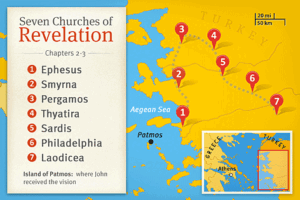 notes on these Seven Churches and what God has to say about each one of them. Each of these churches serves as a reflection to the character and image of modern day churches. The churches should heed to the same warnings.